
Can you trace one lot (or batch) of your finished goods back to its suppliers and forward to every customer in under an hour? That is the practical test of any food recall system and it is one every manufacturer and distributor should be ready for.
Recalls aren't rare. Food Standards Australia New Zealand (FSANZ) coordinated 92 food recalls in 2025, above the 10-year average of 87. Under the Food Standards Code, every food manufacturer, importer and wholesale supplier must also have a written recall plan.
But a plan on paper is only half the job. If the honest answer to that opening question involves phone calls, paper dockets and someone's memory, this guide will show you where the gaps are.
Run the trace
Pick a finished-goods lot from the last few months, ideally one with a busy history and start the clock.
- Find the lot. Pull up its record in your system.
- Trace backwards. Identify which raw material lots went into it and from which suppliers.
- Trace forwards. Follow the same lot to every delivery: each customer, date and quantity.
- Build the list. Pull the affected customers and contacts together. This is your notification list.
- Check it against reality. Compare a sample against delivery dockets and stock on hand. Does every unit add up?
Under an hour, with numbers that reconcile, means your traceability is in good shape. The hour is a benchmark, not a regulatory deadline.
Where it usually breaks
A food recall system is only as good as the data behind it. When a recall falls short, the cause is usually one of these:
- Lot tracking isn't on for every product that needs it. Raw materials added later are often missed.
- Lots aren't captured at goods receipt. The backward trace stops at your dock.
- Ingredients are consumed without a lot reference. You know what was used, not which lot.
- Rework and split lots aren't recorded. One lot becomes three and the link is lost.
- Best-before dates are on handwritten labels. Your system can't see them.
- Customer contacts are out of date. The recall notice goes to someone who left two years ago.
Most of these are process fixes rather than technology problems.
"There is no batch, the line runs continuously"
Continuous lines are harder to trace but not impossible. Consumed and produced lots can be linked by time, i.e. if a raw material lot was feeding the line between 9:00 and 11:30, the output in that window is linked to it, pro-rata.
It takes deliberate set-up, so it is worth weighing against the scale of the risk.
"We know it is FIFO because the picker remembers"
The same lot data also helps you rotate stock.
Most warehouses pick the oldest stock first (FIFO). In food, though, the oldest stock isn't always the stock that expires first. A newer delivery can arrive with a shorter shelf life. If pickers go by age, that stock gets left behind and ends up written off.
When best-before dates are recorded in your system, it can direct pickers to the stock that expires first (FEFO).
Printing lot numbers and dates on delivery dockets helps your customers too. Their receiving team can check each pallet on arrival, which means fewer rejected deliveries.
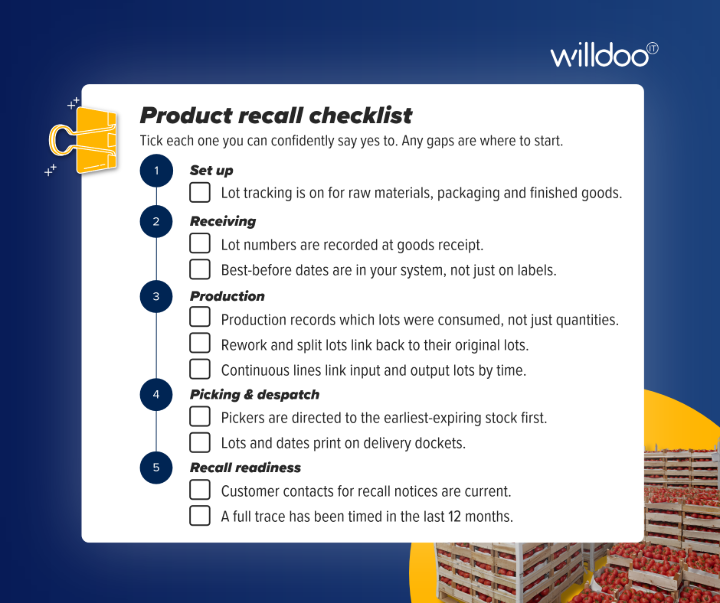
Each of these comes down to the same thing: capturing the right data at the right point. Use this checklist to spot the likely gaps before you run your first trace:
Start with one lot
You don't need a full audit to find out where you stand. One lot and an hour will tell you whether your data can carry a recall and the same fixes that close the gaps will also cut write-offs along the way.
Better to find out in a test than in the real thing.
Want to talk through your results or tighten up traceability in your business? Get in touch with our team. We are happy to help.